Autor: ferch.barba@gmail.com

  • Most Common Prostate Symptoms

    Most Common Prostate Symptoms

    ☎️ Appointments: 9995 14 31 65

    ✉️ Mail: info@prostasur.mx

    Mérida, Yucatán 

    Blog Prostasur

    Urology clinic for men
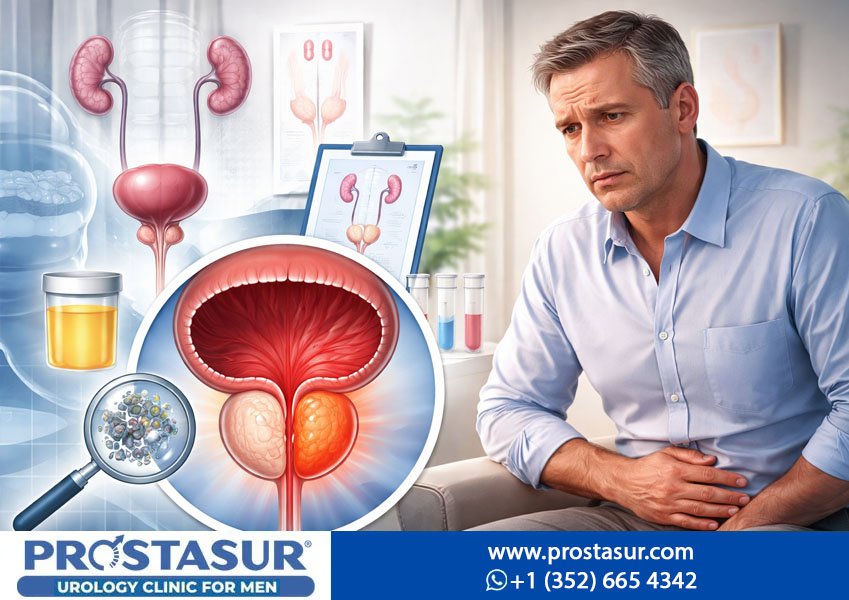
    Most Common Prostate Symptoms

    The prostate is a small gland found only in men, located below the bladder and in front of the rectum. Its main function is to produce part of the seminal fluid. As men age—especially after 40–50 years—the prostate may develop different conditions that cause urinary and general symptoms that should not be ignored.

    Recognizing these symptoms early can make a significant difference in quality of life and in the early detection of diseases.

    1. Difficulty urinating

    One of the most common symptoms. A person may feel that:

    • It is hard to start urinating
    • The urine stream is weak or intermittent
    • Straining is required to urinate

    This happens because the prostate surrounds the urethra and, when it enlarges, it can compress it.

    1. Increased urinary frequency

    It is common to feel the need to urinate:

    • More often during the day
    • Several times during the night (nocturia)

    This can occur even when only small amounts of fluids have been consumed.

    1. Feeling of incomplete bladder emptying

    After urinating, there may be a sensation that the bladder has not fully emptied, causing discomfort and a constant need to return to the bathroom.

    1. Urinary urgency

    A sudden and intense need to urinate that is difficult to control. In some cases, small urine leaks may occur if the bathroom is not reached in time.

    1. Burning or pain during urination

    This may include:

    • A burning sensation
    • Pain in the urethra or lower abdomen

    This symptom is more common when there is prostate inflammation or infection.

    1. Pelvic or lower back pain

    Some men experience pain or discomfort in:

    • The lower abdomen
    • The pelvic region
    • The lower back
    • The perineum (the area between the testicles and the anus)
    1. Changes in ejaculation

    Prostate problems may cause:

    • Pain during ejaculation
    • Reduced semen volume
    • Weak or uncomfortable ejaculation
    1. Blood in urine or semen

    Although uncommon, hematuria (blood in the urine) or blood in the semen is a warning sign that requires immediate medical evaluation.

    1. Recurrent urinary tract infections

    Obstruction of urine flow can lead to urine retention, increasing the risk of repeated infections.

    Important to note

    These symptoms may be related to:

    • Benign prostatic hyperplasia
    • Prostatitis
    • Other prostate conditions

    Not all symptoms indicate cancer, but all of them deserve medical attention.

    When to see a doctor

    Medical evaluation is recommended if:

    • Symptoms persist or worsen
    • They interfere with daily life
    • They appear after the age of 40
    • There is severe pain or the presence of blood

    Early evaluation allows proper treatment and helps prevent complications.

    Remember that at Prostasur, a urology clinic, we are here to serve you.

    ☎️ Appointments: 9995 14 31 65

    ✉️ Mail: info@prostasur.mx

    Prostasur

    COFEPRIS 213301202A0698
  • Why Does the Prostate Grow?

    Why Does the Prostate Grow?

    ☎️ Appointments: 9995 14 31 65

    ✉️ Mail: info@prostasur.mx

    Mérida, Yucatán 

    Blog Prostasur

    Urology clinic for men

    Why Does the Prostate Grow?

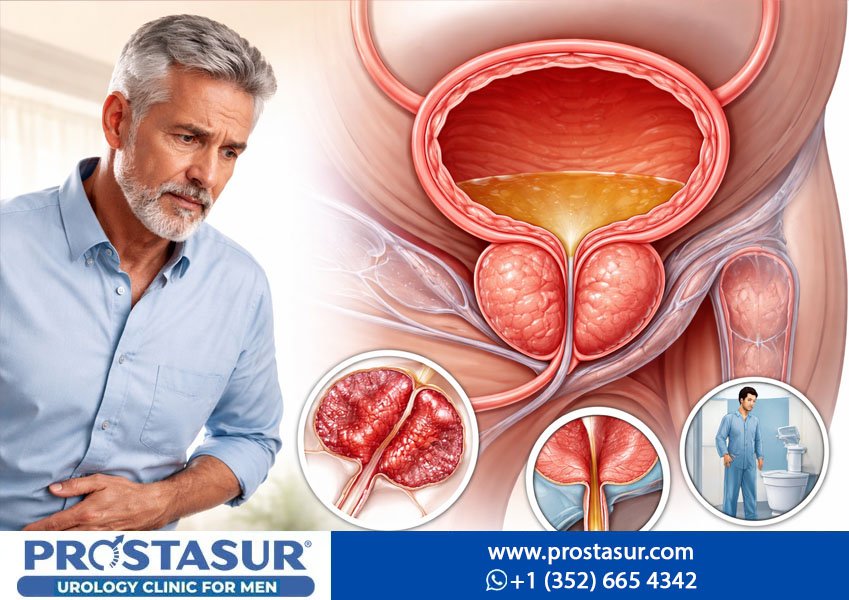
    Prostate growth is a common condition in men, especially after the age of 40 or 50. Although it often causes concern, in most cases it is not related to cancer, but rather to a natural process of male aging. To better understand it, let’s first look at what the prostate is and then explore why it increases in size.

    What Is the Prostate and What Is Its Function?

    The prostate is a gland about the size of a walnut that is part of the male reproductive system. It is located just below the bladder and surrounds the urethra, the tube through which urine and semen pass.

    Its main function is to produce a fluid that forms part of semen, helping to nourish and protect sperm.

    Main Reasons Why the Prostate Grows

    1. Hormonal Changes With Age

    The most common cause of prostate growth is hormonal imbalance that occurs over time.
    Although testosterone levels gradually decrease, the influence of a hormone derived from it, called dihydrotestosterone (DHT), increases. This hormone stimulates the growth of prostate cells.

    This process can lead to what is known as benign prostatic hyperplasia (BPH), a non-cancerous but very common condition.

    1. Natural Aging

    Prostate growth is so closely linked to age that many specialists consider it a normal part of male aging. Statistically:

    • More than 50% of men over the age of 60 have some degree of prostate enlargement.
    • After the age of 80, this percentage exceeds 80%.
    1. Genetic Factors

    If there is a family history of prostate problems, the risk of developing prostate enlargement increases.
    Genetics can influence both the age of onset and the severity of symptoms.

    1. Lifestyle and Habits

    Certain habits can contribute to or worsen prostate growth:

    • Sedentary lifestyle
    • Overweight or obesity
    • Diet high in saturated fats and low in fiber
    • Excessive alcohol consumption
    • Smoking

    Although these factors are not always the direct cause, they do influence the progression of the condition.

    1. Prostate Inflammation (Prostatitis)

    Chronic inflammation of the prostate can cause an increase in its size and urinary symptoms.
    In some cases, repeated or poorly treated infections contribute to prostate enlargement.

    What Symptoms Can Prostate Growth Cause?

    When the prostate increases in size, it can compress the urethra and make it difficult for urine to pass. The most common symptoms include:

    • Difficulty starting urination
    • Weak urine stream
    • Feeling of incomplete bladder emptying
    • Frequent urge to urinate, especially at night
    • Dribbling at the end of urination

    Is Prostate Growth Cancer?

    Not necessarily.
    Benign prostatic hyperplasia and prostate cancer are different conditions, although they can coexist. That is why regular medical checkups are essential, especially from the age of 45–50 onward.

    Remember that at Prostasur, a urology clinic, we are here to serve you.

    ☎️ Appointments: 9995 14 31 65

    ✉️ Mail: info@prostasur.mx

    Prostasur

    COFEPRIS 213301202A0698

  • Love, Pleasure, and Care: What You Should Know About Sexually Transmitted Infections This Valentine’s Day

    Love, Pleasure, and Care: What You Should Know About Sexually Transmitted Infections This Valentine’s Day

    ☎️ Appointments: 9995 14 31 65

    ✉️ Mail: info@prostasur.mx

    Mérida, Yucatán 

    Blog Prostasur

    Urology clinic for men

    Love, Pleasure, and Care: What You Should Know About Sexually Transmitted Infections This Valentine’s Day

    February 14th is usually associated with flowers, romantic dinners, sweet messages, and moments of intimacy. It’s a date that celebrates love in all its forms, but there’s something that is rarely mentioned and that is also a true act of love: taking care of your sexual health.

    Talking about Sexually Transmitted Infections (STIs) shouldn’t be uncomfortable or frightening. On the contrary, information is a tool for protection, trust, and shared responsibility.

    What Are Sexually Transmitted Infections?

    STIs are infections that are mainly transmitted through unprotected sexual contact: vaginal, anal, or oral. They can also be transmitted through contact with blood, from mother to child during pregnancy or childbirth, and in some cases through direct contact with skin lesions.

    The key thing to understand is that anyone can get an STI, regardless of age, gender, sexual orientation, or whether they are in a stable relationship.

    The Most Common STIs

    Some of the most common infections include:

    • Human Papillomavirus (HPV): Very common. Many people have it without knowing it. Some strains cause genital warts, while others are linked to cancer.
    • Chlamydia and gonorrhea: Often asymptomatic, but they can lead to infertility if left untreated.
    • Syphilis: It may start as a mild sore, but without treatment it can damage vital organs.
    • Genital herpes: Causes painful blisters; there is no cure, but treatment can control outbreaks.
    • HIV: Attacks the immune system. Today, with early diagnosis, people can live long and healthy lives.

    The Danger of “Nothing Happened”

    One of the biggest risks surrounding STIs is the false sense of security:

    “I look healthy,”
    “It’s someone I trust,”
    “It only happened once,”
    “Nothing happened.”

    Many STIs do not cause symptoms for months or even years, which makes transmission easier without anyone realizing it. Silence does not protect you; information does.

    Self-Care Is Also a Form of Love

    Taking care of yourself is not a sign of distrust—it’s a sign of self-respect. And taking care of your partner is not unromantic; it’s emotional and physical responsibility.

    Simple actions that make a big difference include:

    • Correct and consistent condom use
    • Regular STI testing, even in stable relationships
    • Open communication with your partner about sexual health
    • Vaccination against HPV and hepatitis B
    • Avoiding sexual contact if there are sores, discharge, or discomfort without medical evaluation

    Conscious Love This Valentine’s Day

    The real act of love is not just the intimate moment, but what you do before and after: staying informed, protecting yourself, and caring for the other person.

    This Valentine’s Day, in addition to giving flowers or chocolates, give yourself something far more valuable:
    health, peace of mind, and shared responsibility.

    Because loving also means preventing.
    Because pleasure and care can coexist.
    Because when you take care of yourself, you are also saying “I love you.”

    Remember that at Prostasur, a urology clinic, we are here to serve you.

    ☎️ Appointments: 9995 14 31 65

    ✉️ Mail: info@prostasur.mx

    Prostasur

    COFEPRIS 213301202A0698

  • Prostate Enlargement: What Every Man Should Know

    Prostate Enlargement: What Every Man Should Know

    ☎️ Appointments: 9995 14 31 65

    ✉️ Mail: info@prostasur.mx

    Mérida, Yucatán 

    Blog Prostasur

    Urology clinic for men

    Prostate Enlargement: What Every Man Should Know

    Prostate enlargement is a common condition in men, especially after the age of 40–50. Although it often causes concern, in most cases it is not cancer, but rather a natural process associated with aging. Understanding what it is, why it happens, and how it can be treated is key to maintaining a good quality of life.

    What Is the Prostate and What Is Its Function?

    The prostate is a gland about the size of a walnut, located below the bladder and in front of the rectum. Its main function is to produce part of the seminal fluid, which helps protect and nourish sperm.

    As men age, the prostate may increase in size and press against the urethra (the tube through which urine passes), leading to various urinary symptoms.

    What Is Prostate Enlargement?

    Prostate enlargement, medically known as benign prostatic hyperplasia (BPH), is a non-cancerous increase in the size of the prostate.
    It is a very common condition:

    • More than 50% of men over the age of 50 have it
    • Up to 80% of men over the age of 70 experience some degree of prostate enlargement

    Main Symptoms

    Symptoms can range from mild to severe and usually develop gradually:

    • Difficulty starting urination
    • Weak or interrupted urine stream
    • Feeling that the bladder does not empty completely
    • Increased urinary frequency, especially at night (nocturia)
    • Urgency to urinate
    • Dribbling after urination

    👉 It is important to note that the severity of symptoms does not always correlate with the size of the prostate.

    Why Does Prostate Enlargement Occur?

    Although the exact cause is not fully understood, it is mainly associated with:

    • Age-related hormonal changes
    • A relative increase in estrogen levels in adult men
    • Genetic factors
    • Sedentary lifestyle
    • Overweight and poor diet

    Diagnosis

    Diagnosis usually includes:

    • Medical history and symptom evaluation
    • Digital rectal examination
    • Blood tests (PSA)
    • Urine tests
    • Prostate ultrasound
    • Urinary flow studies (uroflowmetry)

    Early diagnosis helps prevent complications such as urinary tract infections, urinary retention, or kidney damage.

    Treatment Options

    Treatment depends on the severity of symptoms:

    1. Active Surveillance

    In mild cases, monitoring and lifestyle changes may be sufficient.

    2. Medical Treatment

    • Alpha-blockers (to improve urine flow)
    • 5-alpha reductase inhibitors (to reduce prostate size)

    3. Surgical Treatment

    Recommended when symptoms are severe or complications arise. Both minimally invasive techniques and traditional surgeries are available.

    Lifestyle Changes That Can Help

    • Maintain a healthy weight
    • Engage in regular physical activity
    • Reduce alcohol and caffeine intake
    • Avoid drinking fluids before bedtime
    • Do not delay urination
    • Follow a diet rich in fruits, vegetables, and healthy fats

    When Should You See a Doctor?

    You should consult a specialist if:

    • There is persistent difficulty urinating
    • Recurrent urinary tract infections occur
    • Pain, blood in the urine, or urinary retention is present
    • Symptoms significantly affect quality of life

    Remember that at Prostasur, a urology clinic, we are here to serve you.

    ☎️ Appointments: 9995 14 31 65

    ✉️ Mail: info@prostasur.mx

    Prostasur

    COFEPRIS 213301202A0698