☎️ Appointments: 9995 14 31 65
✉️ Mail: info@prostasur.mx

Mérida, Yucatán
Blog Prostasur
Urology clinic for men
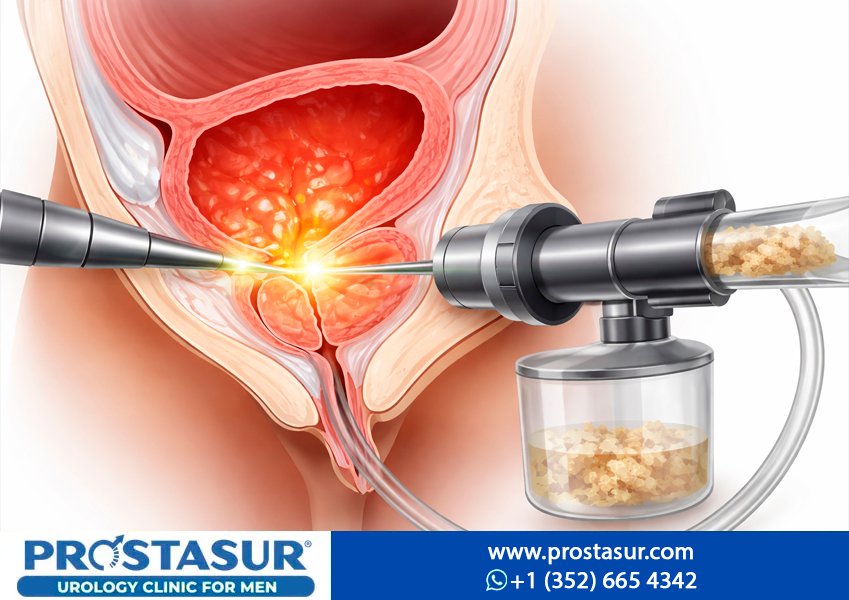
HoLEP: Holmium Laser Enucleation of the Prostate
HoLEP (Holmium Laser Enucleation of the Prostate) is a minimally invasive surgical technique used to treat Benign Prostatic Hyperplasia (BPH), a common condition in older men in which the prostate enlarges and obstructs the normal flow of urine.
In recent years, HoLEP has become one of the most effective and safest alternatives for treating large prostates, offering results comparable to—or even better than—traditional open surgery, while allowing for a much faster recovery.
What is HoLEP?
HoLEP is an endoscopic procedure that uses a holmium laser to separate and remove the prostate tissue that is blocking the urethra.
Unlike some other surgical procedures, HoLEP does not require external incisions, since the entire procedure is performed through the urethra using an instrument called a resectoscope.
The procedure involves two main steps:
- Enucleation: the laser separates the enlarged prostate tissue from the prostatic capsule.
- Morcellation: the detached tissue is fragmented inside the bladder so it can be removed.
This approach allows surgeons to remove large amounts of tissue with a high degree of precision.
What is HoLEP used for?
HoLEP is primarily used to treat urinary symptoms caused by Benign Prostatic Hyperplasia, such as:
- Difficulty starting urination
- Weak urinary stream
- Feeling of incomplete bladder emptying
- Frequent urination, especially at night (nocturia)
- Urinary urgency
- Urinary retention
When medications are no longer effective, or when the prostate becomes significantly enlarged, surgery is often the best treatment option.
How is the procedure performed?
The HoLEP procedure is typically performed under general or spinal anesthesia and usually takes between 60 and 120 minutes, depending on the size of the prostate.
Steps of the procedure
- An endoscope is inserted through the urethra until it reaches the prostate.
- The holmium laser is used to separate the enlarged prostate tissue.
- The tissue is pushed into the bladder.
- A device called a morcellator is used to fragment the tissue.
- The fragments are removed through the endoscope.
After the surgery, a urinary catheter is temporarily placed to allow the bladder to drain.
Advantages of HoLEP
HoLEP offers several advantages compared with other prostate procedures.
- Effective for large prostates
Unlike many other techniques, HoLEP can treat prostates of almost any size, including very large ones.
- Reduced bleeding
The laser seals blood vessels while cutting, significantly reducing blood loss.
- Faster recovery
Most patients are able to go home within 24 hours.
- Long-lasting results
The complete removal of obstructive tissue lowers the likelihood of needing additional surgery in the future.
- Shorter catheterization time
In many cases, the catheter can be removed the next day.
Possible side effects
As with any surgical procedure, HoLEP may have some side effects, although they are usually temporary.
The most common include:
- Burning sensation during urination in the first few days
- Blood in the urine
- Temporary urinary urgency
- Retrograde ejaculation
- Temporary urinary incontinence
Serious complications are uncommon.
Comparison with other prostate surgeries
HoLEP is often compared with procedures such as:
- Transurethral Resection of the Prostate (TURP)
- Open Prostatectomy
While TURP has long been considered the standard treatment for moderately enlarged prostates, HoLEP has demonstrated equal or superior effectiveness, particularly for large prostates, with less bleeding and a lower likelihood of requiring repeat surgery.
Recovery after HoLEP
Recovery is usually quick, but patients are advised to take certain precautions during the first few weeks:
- Drink plenty of water
- Avoid heavy lifting
- Avoid intense physical activity
- Refrain from sexual activity for 3–4 weeks
Most patients experience significant improvement in urinary flow and overall quality of life within a few weeks after the procedure.
Remember that at Prostasur, a urology clinic, we are here to serve you.
☎️ Appointments: 9995 14 31 65
✉️ Mail: info@prostasur.mx
Prostasur
COFEPRIS 213301202A0698