☎️ Appointments: 9995 14 31 65
✉️ Mail: info@prostasur.mx

Mérida, Yucatán
Blog Prostasur
Urology clinic for men
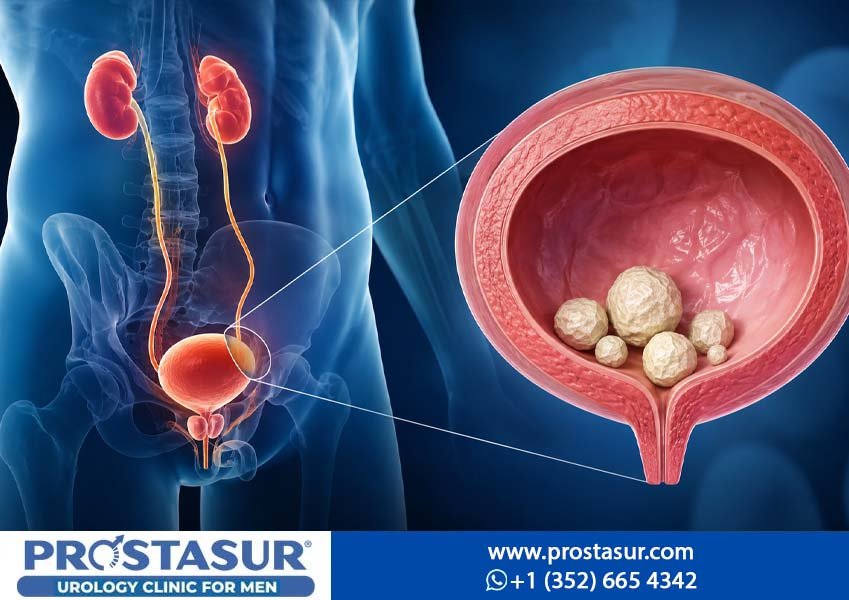
Bladder Stones: Symptoms, Causes, and Treatment
Bladder stones are hard deposits of minerals that form inside the urinary bladder. Although they may be small and go unnoticed, they can also grow over time, causing significant discomfort, urinary tract infections, and even bladder damage if left untreated.
In this article, we explain what bladder stones are, why they develop, their symptoms, and the available treatment options.
What Are Bladder Stones?
Bladder stones are hard masses of crystallized minerals that develop when urine remains in the bladder for too long and is not completely emptied. As the urine becomes more concentrated, the minerals it contains begin to crystallize, eventually forming stones.
Their size can range from just a few millimeters to several centimeters.
What Causes Bladder Stones?
The most common cause is incomplete bladder emptying. When urine remains in the bladder after urination, minerals have a greater opportunity to crystallize and form stones.
Common risk factors include:
- Benign enlargement of the prostate (benign prostatic hyperplasia, or BPH), which blocks urine flow.
- Neurological disorders that affect bladder function.
- Recurrent urinary tract infections.
- Foreign bodies in the bladder, such as urinary catheters.
- Bladder diverticula.
- Kidney stones that migrate into the bladder.
- Previous injuries or surgeries involving the urinary tract.
In men, an enlarged prostate is one of the leading causes of bladder stone formation.
Symptoms of Bladder Stones
Some people experience no symptoms, especially when the stones are small. However, as they grow or begin to irritate the bladder, they may cause:
- Lower abdominal pain.
- Pain or burning during urination.
- Frequent urination.
- Difficulty starting or maintaining the urine stream.
- Interruption of the urine stream.
- Blood in the urine (hematuria).
- Cloudy or foul-smelling urine.
- Recurrent urinary tract infections.
In more advanced cases, a bladder stone can block the flow of urine, leading to urinary retention, a condition that requires immediate medical attention.
How Are Bladder Stones Diagnosed?
Diagnosis begins with a medical evaluation and a review of the patient’s symptoms.
A urologist may recommend one or more of the following tests:
- Urinalysis to detect blood or signs of infection.
- Urinary tract ultrasound.
- Plain abdominal X-ray, when the type of stone is visible on X-ray.
- Computed tomography (CT) scan, one of the most accurate imaging methods for detecting bladder stones.
- Cystoscopy, a procedure that uses a thin camera to examine the inside of the bladder directly.
These tests help confirm the presence of bladder stones and identify the underlying cause.
Treatment
Treatment depends on the size of the stone, the patient’s symptoms, and the underlying cause.
Small Bladder Stones
In some cases, increasing fluid intake may help pass very small bladder stones naturally. However, spontaneous passage is relatively uncommon.
Lithotripsy (Stone Fragmentation)
This is the most common treatment. A specialized instrument is inserted through the urethra to locate the stone, which is then broken into smaller pieces using laser or ultrasonic energy. The fragments are removed during the procedure or passed naturally through urination.
This minimally invasive procedure usually allows for a quick recovery.
Surgery
When bladder stones are very large or when significant anatomical abnormalities are present, surgical removal may be necessary.
In addition to removing the stone, it is essential to treat the underlying cause—such as an enlarged prostate or bladder dysfunction—to reduce the risk of recurrence.
Can Bladder Stones Be Prevented?
Yes. Several measures can significantly reduce the risk of developing bladder stones:
- Stay well hydrated.
- Avoid delaying urination when you feel the urge.
- Seek prompt treatment for urinary tract infections.
- Consult a healthcare provider if you have difficulty emptying your bladder.
- Manage prostate conditions or neurological disorders that affect bladder function.
People with a history of urinary stones should have regular follow-up visits with their urologist to detect any recurrence early.
When Should You See a Urologist?
You should consult a urologist if you experience:
- Blood in your urine.
- Persistent pain or burning during urination.
- Recurrent urinary tract infections.
- Difficulty emptying your bladder.
- Frequent interruption of the urine stream.
- Severe lower abdominal pain.
Early diagnosis and treatment can prevent complications and protect your urinary health.
Remember that at Prostasur, a urology clinic, we are here to serve you.
☎️ Appointments: 9995 14 31 65
✉️ Mail: info@prostasur.mx
Prostasur
COFEPRIS 213301202A0698