☎️ Appointments: 9995 14 31 65
✉️ Mail: info@prostasur.mx

Mérida, Yucatán
Blog Prostasur
Urology clinic for men
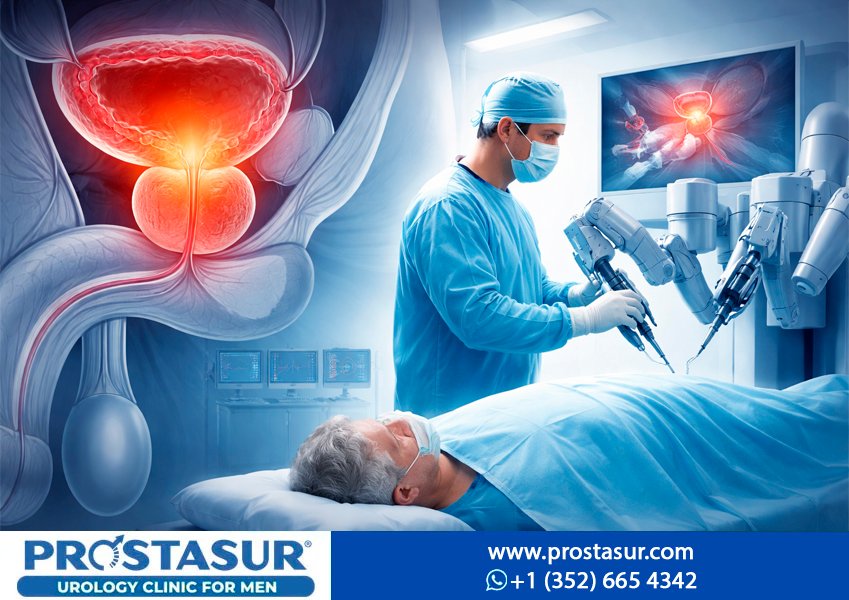
Prostate Surgery: When It Is Needed, Types, and Recovery
The prostate is a small gland of the male reproductive system located below the bladder and in front of the rectum. Its main function is to produce part of the seminal fluid that protects and transports sperm. Over time, this gland can develop different problems that, in some cases, require surgical treatment.
Prostate surgery refers to a group of medical procedures used to treat diseases that affect this gland, especially when medications are no longer effective or when the condition poses a risk to the patient’s health.
Main Conditions That May Require Surgery
Several conditions can affect the prostate. The most common include:
- Benign Prostatic Hyperplasia (BPH)
Benign Prostatic Hyperplasia is a noncancerous enlargement of the prostate. It is very common in men over the age of 50.
As the prostate grows, it can press against the urethra and cause urinary symptoms such as:
- Difficulty starting urination
- Weak urinary stream
- Feeling that the bladder does not empty completely
- Frequent need to urinate, especially at night
When these symptoms become severe or do not improve with medication, surgery may be recommended.
- Prostate Cancer
Prostate Cancer is one of the most common cancers in men. In some cases—especially when the tumor is localized—surgery can be one of the main treatment options.
- Complicated Prostatitis
Prostatitis is inflammation of the prostate, usually caused by infection. Although most cases are treated with medication, complicated or chronic situations may require surgical procedures.
Types of Prostate Surgery
Depending on the prostate condition, the patient’s age, and the severity of the disease, the doctor may recommend different surgical techniques.
- Transurethral Resection of the Prostate (TURP)
Transurethral Resection of the Prostate is one of the most common surgeries used to treat benign prostatic hyperplasia.
How is it performed?
- The surgeon inserts an instrument called a resectoscope through the urethra.
- No external incisions are required.
- The prostate tissue blocking the urinary flow is removed.
Advantages
- Shorter recovery time
- No external scars
- Rapid improvement of urinary symptoms
- Radical Prostatectomy
Radical Prostatectomy involves the complete removal of the prostate gland and, in some cases, surrounding tissues.
It is mainly used to treat localized prostate cancer.
It can be performed through:
- open surgery
- laparoscopic surgery
- robot-assisted surgery
One of the most advanced techniques is robotic surgery using the da Vinci Surgical System, which allows greater precision and less damage to surrounding tissues.
- Laser Prostate Surgery
This procedure uses laser energy to remove or vaporize prostate tissue that blocks the urethra.
Some of the best-known techniques include:
- Laser prostate enucleation
- Laser prostate vaporization
Advantages
- Less bleeding
- Faster recovery
- Shorter hospital stay
Risks and Possible Complications
Like any surgical procedure, prostate surgery may have some complications, although many are uncommon.
The most common include:
- Bleeding
- Urinary tract infection
- Temporary urinary incontinence
- Erectile dysfunction
- Retrograde ejaculation (semen flows into the bladder instead of exiting through the penis)
It is important to note that many of these complications depend on the technique used and the surgeon’s experience.
Recovery After Surgery
Recovery time may vary depending on the type of surgery performed.
In general:
- The patient may stay in the hospital for 1 to 3 days.
- A urinary catheter is usually placed for a few days to allow healing.
- Most patients can resume normal activities within 2 to 6 weeks.
During recovery, doctors usually recommend:
- Avoid lifting heavy objects
- Drink plenty of water
- Avoid straining while urinating or during bowel movements
- Carefully follow medical instructions
Importance of Early Diagnosis
Many men avoid seeing a doctor when they experience urinary symptoms due to embarrassment or because they consider them a normal part of aging. However, early diagnosis can prevent complications and allow for less invasive treatments.
Men over 50 years old (or earlier if there is a family history) are encouraged to have regular medical checkups to detect prostate problems early.
Remember that at Prostasur, a urology clinic, we are here to serve you.
☎️ Appointments: 9995 14 31 65
✉️ Mail: info@prostasur.mx
Prostasur
COFEPRIS 213301202A0698